

The Tarot Year: December 2-12
- mathewharaldssonta
- Dec 2, 2021
- 11 min read
Updated: Nov 4, 2022

the decan
the IX of wands represents the middle Sagittarius decan, roughly December 2-12.
what does the 9 of wands mean in tarot?
this is Strength, Great Strength, Strength in Opposition – you get the picture – bloody strong. if you’ve ever argued with a good old-fashioned Sagittarius, you may recognise the ‘opposition’ part of this. but opposition to what? and hasn’t the meaning of ‘strength’ changed over time?
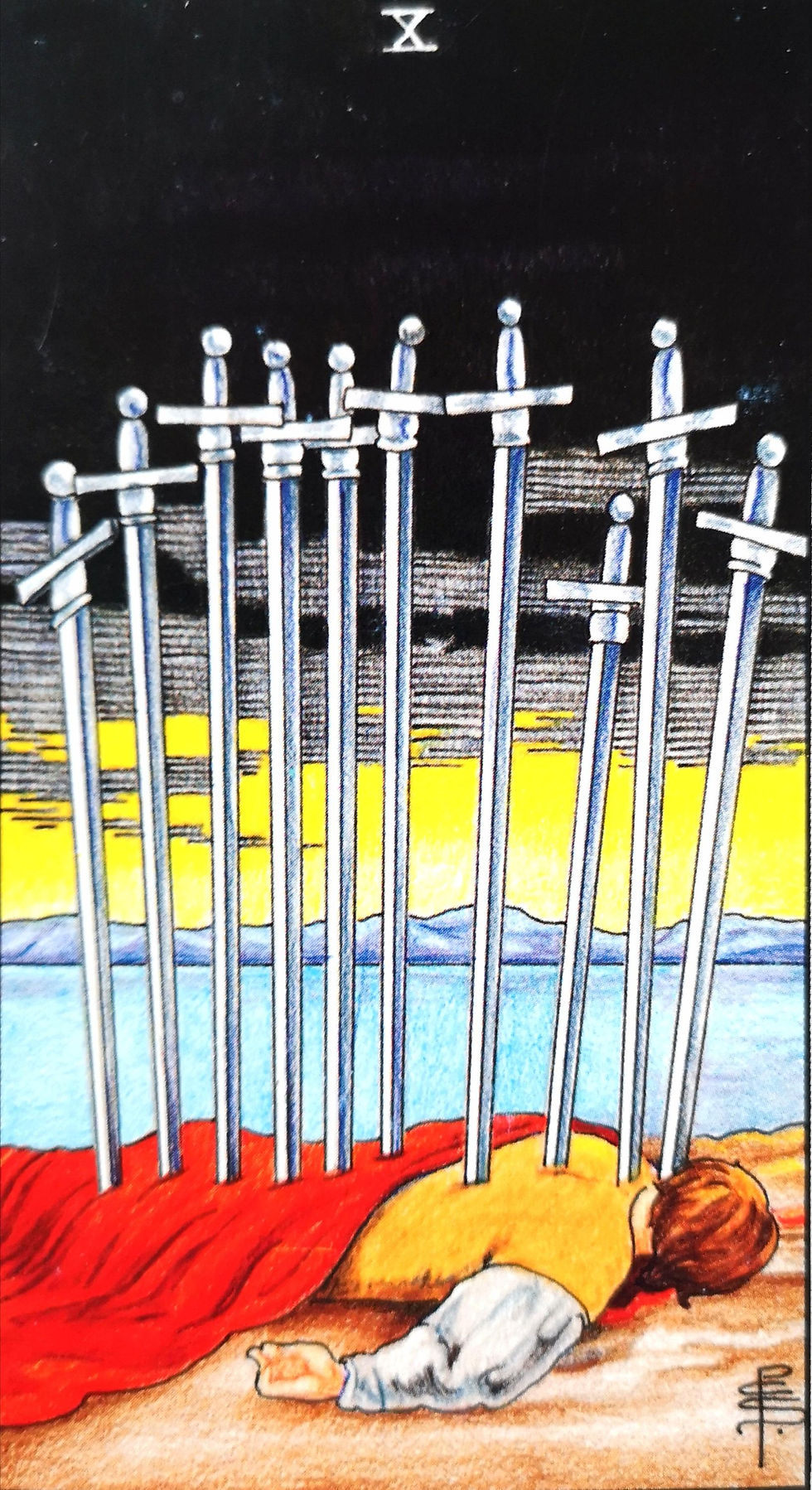
what does the 10 of swords mean in tarot?
the Tarot I drew to read this decan is X of swords, Ruin – a Gemini card, Sagittarius’s opposite sign. the immediate message here is to reflect on how far we’ve come in the last six months – and to remember some battles can only lead to exhaustion, overwhelm, and defeat, and a new way needs to be found, or a different kind of strength brought into play.
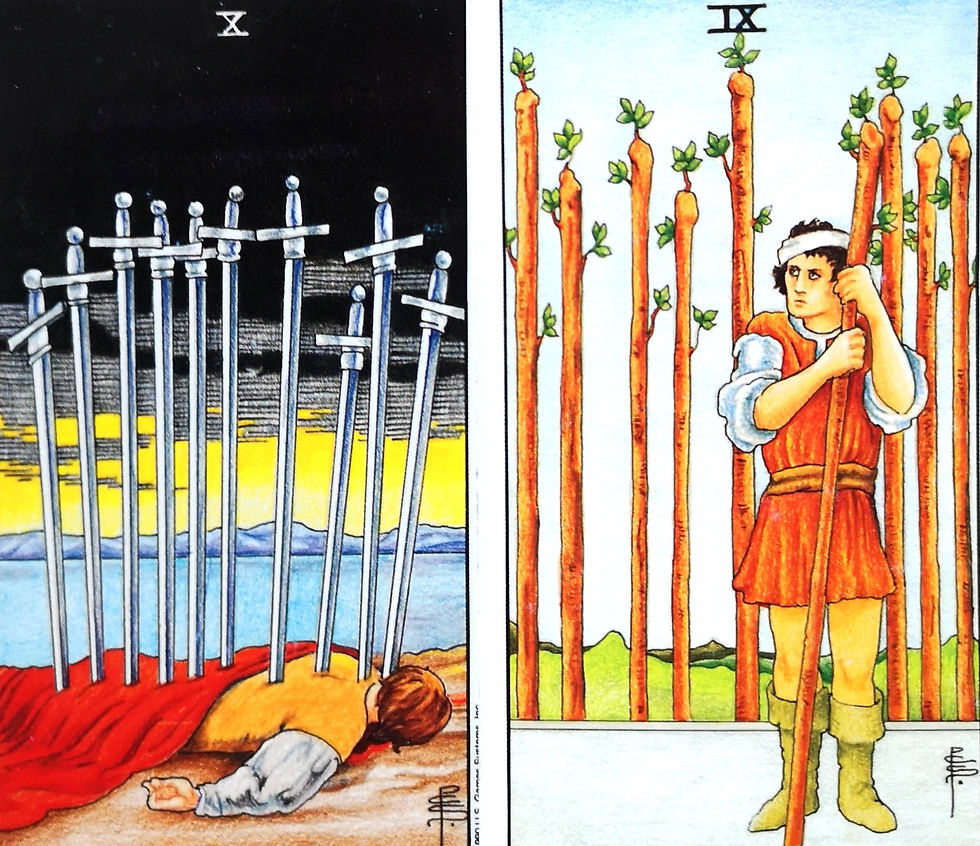
together, these cards speak of completion and beginning following on from difficulty, so the picture isn’t bleak, and we might look at these ten days as a time to reflect on our achievements, accomplishments, attainments – and as a time to soften, and allow the stress and the strain to fade away – or a time to prepare for the next round, knowing we have done all in our power.
the advice
anger shows us where we are vulnerable; knowing our vulnerabilities makes us strong
find your strength by knowing where you are weak
if conflict is a habit, break it – find a different kind of strength
patience, silence, softness, vulnerability – these are strengths, too
standing your ground and letting go both require strength, albeit different kinds
tension is not strength, but letting yourself rest is
are you strong enough to overcome yourself?
don’t just go onwards, go upwards
not every change is good; defend the tradition where your identity sits
don’t try to hold back the sea – the only thing that lasts for ever is forever
the symbols
in the IX we have the Moon in Sagittarius, and in the X, the Sun in Gemini. Sagittarius is the first sign in the mutable sequence of the Tarot Year, running Sagittarius to Pisces. and the X looks back, as it were, to 6 months ago, and its opposite, mutable sign, Gemini. the Sun and the Moon, day and night, opposite signs – before we even arrive at Strength in Opposition.
the RWS IX is well resourced (– the wands at their back –), well defended (– the barrier of the wands –) capable and strong (– their rugged body –), and has experience (– their injury, showing past battles won). like the VII of wands, this is someone working hard, but staying on top.

here, again, we have two pairs of two, and a four. without rehearsing this in too much depth (see VIII wands blog for more on this), the number eight is made of a series of doubles 2+2 and 2+2, and 4+4 – creating a complex pattern, representing a balance of the spiritual and material, but one that can trap us in the mistaken belief we have nothing left to learn. we see this pattern firstly in the ordering of the eight wands in the VIII, then again in the IX.
the ninth staff arrives to split the pair of two and the group of four, forcing its way into the centre. the effect is of “splitting” the two groups of four, forcing a new reality, and of course causing the injury to the head by doing so.
this symbolises the reordering of our knowledge when we realise, we must go beyond the balance of the spiritual and material, to higher realisations of self and integration. as Cooper writes, in Celtic symbology, nine is “a central number with the eight directions and the centre making nine.”

the Heaven and Earth Tarot captures this beautifully – preserving the pairs of twos and group of four from the RWS VIII, and placing the figure in the middle of them, holding the ninth staff. this literally represents the strength we must have to integrate a new way of being which requires us to reorder our reality, and place something new in the centre of our perspective.
the figure in the RWS IX seizes the first staff of the group of four – in a defensive gesture, of holding onto the known. given this reordering, this moment could represent the need for time to assimilate new understanding, and the strength to be patient.
indeed, Waite says if this person is attacked, they “will meet an onslaught boldly; and his build shews, that he may prove a formidable antagonist.” this strength of the IX can turn out to be negative – Rachel Pollack writes that the nines “show how the suits deal with problems” – and their “predilection to fighting can trap wands in patterns of conflicts.”
we see the result of this in the X, a card we might think of as representing half-term holiday syndrome. teachers battle their way to a break – only to collapse into bed, ill. the adrenaline levels which have been kept high by battling the ‘opposition’ suddenly drop and the body’s resistance to infection lowers.
it soon becomes a way of life, for many different people – holding on too tightly to old ideas, dead traditions, outmoded beliefs can all create the habit of conflict – and sometimes we adopt crash positions but forget to unfurl once the challenge has passed. we think we are strong, but really, we are just tense.
but the IX can symbolise the strength of accepting the challenge to integrate new ideas, new traditions, changing beliefs. perhaps this is what the figure in the Ceccoli Tarot is attempting – although, as the lizard was “a symbol of silence,” “divine wisdom and good fortune” (Cooper), they may be resting and preparing for the challenges ahead.

alternatively, the IX can mean “a need to await the arrival of new influences. The necessity of going under, of entering the shadow world of creative forms, of contemplating the play of multiplicity against the backdrop of unity and wholeness” (Lee Irwin) – a Gnostic reading which matches the Ceccoli card very well.
we must consider not only what we need strength to oppose in the world, but also where we need strength to oppose our natural tendency to play safe and stop ourselves from learning and growing – even when new information is available – because of resistance to change.
with the energy of this card, such clinging is likely to be only momentary. the Moon in Sagittarius is a powerful, fluid energy, encouraging thought and mobility – this is a Tarot card about how to deal with being stuck, not of being stuck. at the same time, this is a card of standing one’s ground, and insisting on the correct boundaries.

the 78 Keys Tarot reminds me of the famous Roman proverb, “Let us not confuse change for progress.” for Sandra Thompson, the card can represent “opposition to new ideas” but let’s face it, not every new idea is a good idea just because it's new, and change is not always beneficial – tradition, continuity, stability, family, community, and other more solid qualities are often what we need to support our identities, in order that we may live in this world and progress.
knowing and insisting on your boundaries is an important part of standing one’s ground, although it should be acknowledged this can become toxic if it’s simply a means of control.
once more I find myself disagreeing with the re-coloured version of the RWS. the original captures the vulnerability that lies beneath the defence mechanism of anger. yes, this person will fight you, but they have softer, weaker, more precious things to defend than a bunch of sticks – love, for example, family, and so on. knowing and acknowledging our vulnerability makes us stronger.
the Starspinner brings the vulnerability of Strength in Opposition to the surface in many ways.

the RWS original’s tattered clothes, reddened face, and chin buried behind the shoulder all show his vulnerability, as does the hurt expression of his face.

for me, the recoloured version drains a lot of this away, but it’s important it’s there – because this is also a ‘stage card’ due to the hard border of the rear foreground. who might this person be performing strength in opposition to, or for?

the X is not dissimilar – here we have another row of symbols – both cards have a “prison bars” feel to them – speaking to the completion and renewal aspects of nine and 10 as numbers. the Sensual Wicca Tarot seems to take the idea of being trapped quite literally.

but as Irwin says, the card can mean “Strength and courage in the midst of a dangerous situation, pressures that necessitate drawing on deep inner resources while facing an external threat” and entreating the gods certainly counts on that front.
with these cards we see how situations have built up, and perhaps trapped us to a great degree, but also that they are coming to an end. with the X in the past, the IX is standing their ground, having learned powerful lessons.
with the X in the future, placed to the right of the IX, we may have the example Lee Irwin describes, “A plateau in artistic accomplishments; inspiration that has successfully reached a high level but is now levelling off and losing focus; a distraction from the primary goal due to secondary concerns” – leaving us with the need to deal with the after-effects of climbing high then lying low.
both figures are at ground level – the next challenge is in the distance, on the horizon, the climbing of those mountains – and the moment will surely come when it is time to embrace it, to let the past go, and move onwards and upwards.
beneath the surface
the nines are assigned to Yesod, the sephira of Foundation on the Tree of Life, and where the Moon is the planetary influence. this aspect of the divine is one we can sense in famous remarks such as “Upon this rock I build my church” – for here is the energy to complete monumental tasks.
this is the moment before the final completion of connecting with the sephira of the tens, Malkuth, representing Earth, and physical manifestation. the two are connected by the 32nd pathway on the Tree of Life, represented by XXI The World. this is the moon acting through Saturn upon the Earth.

the Wild Unknown Tarot provides an almost perfect image of ‘moonlight’ descending to earth through a series of nine practical steps and completed refinements.
“Nine,” Cooper tells us, is “Composed of the all-powerful 3×3, it is the Triple Triad; completion; fulfilment; attainment; beginning and end; the whole; a celestial and angelic number; the Earthly Paradise. It is an incorruptible number.”
in that regard, with the IX, and the Moon in Sagittarius, we have the three phases of lunar progress multiplied by three, into the nine. this is the meaning of nine as a perfect number, a number of completion – a triple process of refinement has reached its peak.

spirit, emotions, and ideas have all been refined and that energy is ready to meet the practical influence of Saturn and be transformed into earthly reality. the Lightseer Tarot uses the ninth staff as an image of the 32nd pathway, literally connecting Moon and Earth, Yesod and Malkuth.
well, maybe – because this is X is air in the realm of earth – this is Malkuth in Yetzirah – the X is literally being pinned to the earth and forced to face practicalities. in one sense, this is massively overwhelming, so much so, that the only solution is to let go, and let that new dawn come, as it must.

it is worth remembering that the nines are perfect numbers, as J.C. Cooper tells us, because they always add to the same as their partner number (9+8 = 17; 1+7 = 8), or always multiply to themselves (9×6 = 36; 3+6 = 9). in Qabalism nine is “Pure intelligence; truth, since it reproduces itself when multiplied.”
but Malkuth is the place beyond the nines – a very real world – and not a perfect, ideal one. I forget who said “a confusion of the real and the ideal never goes unpunished” but in one sense that’s what we have here – perhaps, the price of over ambition.
these swords are swords of manifestation – may be this person has got everything they worked so hard for – and it crushes them with exhaustion, responsibility, over-commitment.
people can be ruined by gain – it’s less common than being crushed by poverty, but the misery of certain lottery winners attests to the phenomenon. but these cards suggest the situation is more likely the result of someone having worked too hard, too long, to achieve what they set out to.

Mathers gives the divinatory meaning as “Order, Discipline, Good Arrangement, Disposition; R. Obstacles, Crosses, Delay, Displeasure.” yet the end result may be what Irwin describes as “A defensive stance that has become habitual and is blocking further development.”
as ever with the tens, we have the end and the beginning in the same card. the zero of the 10 symbolises the completed cycle, the void, the infinite, whereas the one of the 10 tells us the situation will change – nothing lasts forever, except forever – and the one represents the ace of the suit – the new beginning implied in every ripening, just as the seed of the ripened fruit signals both completion and the potential of a new cycle.

the Muse Tarot reminds me of this fruity metaphor, combining the image of the threshold guardian with that of emergence into a new self from the old self.
I’ve received the X a few times this year (yay) and I’m always aware it uses one of Pamela Colman Smith’s frequent stylistic devices – that of continuing a line from an object to a figure, to make us connect the qualities of the environment with that of the person in the card.
in the RWS X, the line of the shore extends into the line of the body, telling us that the tide will wash away even this most nightmarish situation, with time. this is not forever. in the image of the rest provided by the Cascadia Tarot, we see another facet of strength – the ability to take time out from the struggle to nourish oneself.

I’m reminded again to quarrel with the recoloured cards. sure, the images are clearer, but the meanings are really changed here. in the X, the pools of blood and streaks of blood from entry wounds are missing. this card has been sanitised, effectively. agonisingly painful experiences do exist, and the Tarot must encompass the full range of human experience, or it is nothing, or certainly less than it can be. changes like this render almost a completely different card, or at least strip out a significant level of emotional complexity.

with the IX, Colman Smith captures the vulnerability of masculine energy – sure, this guy looks punchy, but he’s all heart – he looks hurt – and having softer areas to protect is what gives him the drive to fight. the figure in the newer version, with apologies, just looks baked.
the RuPaul Tarot reminds us strength, potency, and vulnerability often run hand-in-hand.

the staff is an ancient symbol of “Masculine power; authority; dignity; magic power.” the original cards give us, potentially, a narrative of sexual difficulty – the psychic wound of impotence, and the crushing weight of the mind on the body when such difficulties – sometimes purely psychological – weigh the mind down in a powerful, negative spiral.

the direction a figure in a Tarot card is looking in is a good indicator of mental activity. Sandra Thompson says of the IX that looking left indicates “his problem, attitude, or wound has something to do with what he’s carrying from his past, some attitude that he holds on to and of which he is likely unaware.” and Cooper reminds us “The left side is usually the sinister, dark, illegitimate, lunar, inward-looking aspect and represents the past.”
hopefully the figure in the RWS IX is looking back at difficulties that are in the past and moving on to a brighter future, not the ruin of the X, but the coming dawn. as Thompson says of the IX, “he’s getting there; he’s looking and wondering.”
with thanks to the decks and designers – the RWS of Pamela Colman Smith with Mary Hanson-Roberts, Chris-Anne's Muse and Lightseer Tarot, RuPaul’s Drag Race Tarot, Manara, Kim Krans's Tarot, Siri Rose’s Cascadia Tarot, Elisa Poggese’s Sensual Wicca Tarot, Nicoletta Ceccoli’s Tarot, Antonella Platano’s Tarot of the 78 Doors, Jack Sephiroth’s Heaven and Earth Tarot, Marco Proietto’s Capobianco Nero Tarot, MJ Cullinane’s Crow Tarot, and Star Spinner Tarot by Trungles.


Comments